

A solid communication plan is about more than just sending emails and posting on social media. It's the strategic backbone that ensures every message you send—whether to your internal team or your external audience—is consistent, purposeful, and effective.
Building the Foundation for Clear Communication
What really separates a plan that gets results from a document that just gathers dust on a shelf? It's a shift in mindset. A great plan isn't a simple to-do list; it's a strategic roadmap that aligns every single piece of communication with your organization's most important goals.
Without this framework, it’s easy to fall into a reactive trap. Messages get muddled, stakeholders feel left in the dark, and key initiatives can be derailed by nothing more than a simple lack of clarity. A well-designed communication plan prevents this chaos before it even starts.
This table breaks down the core components we'll be exploring. Think of it as your high-level blueprint for building a plan that works.
Core Components of a Strategic Communication Plan
| Component | Purpose | Key Question to Answer |
|---|---|---|
| Objectives | To define what you want to achieve with your communication efforts. | What is the specific, measurable outcome we want? |
| Audience & Stakeholders | To identify everyone you need to reach and understand their needs. | Who needs to know this, and what do they care about? |
| Key Messages | To craft clear, consistent, and compelling core talking points. | What is the single most important thing they must know? |
| Channels & Cadence | To select the right platforms and determine the frequency of messages. | Where and how often does our audience want to hear from us? |
| Roles & Responsibilities | To assign clear ownership for every communication task. | Who is responsible for creating, approving, and sending? |
| Timeline & Calendar | To schedule and coordinate all communication activities. | When will each message be delivered? |
| Measurement & KPIs | To track progress and measure the impact of your efforts. | How will we know if we've succeeded? |
| Templates | To create reusable assets for efficiency and consistency. | What pre-built scripts or documents do we need? |
Each of these pieces is crucial for transforming your communication from an afterthought into a strategic function.
The Strategic Purpose of a Plan
Your plan is your guide for managing expectations, creating a clear framework for decisions, and ensuring everyone stays on the same page.
For a non-profit, this might mean keeping donors engaged with timely updates that build trust and show impact. For a medical practice, it’s about making sure patients get clear, consistent information about their care, which ultimately improves both health outcomes and patient satisfaction.
This visual really gets to the heart of why a plan matters: it's all about preventing confusion, managing expectations, and guiding decisions.
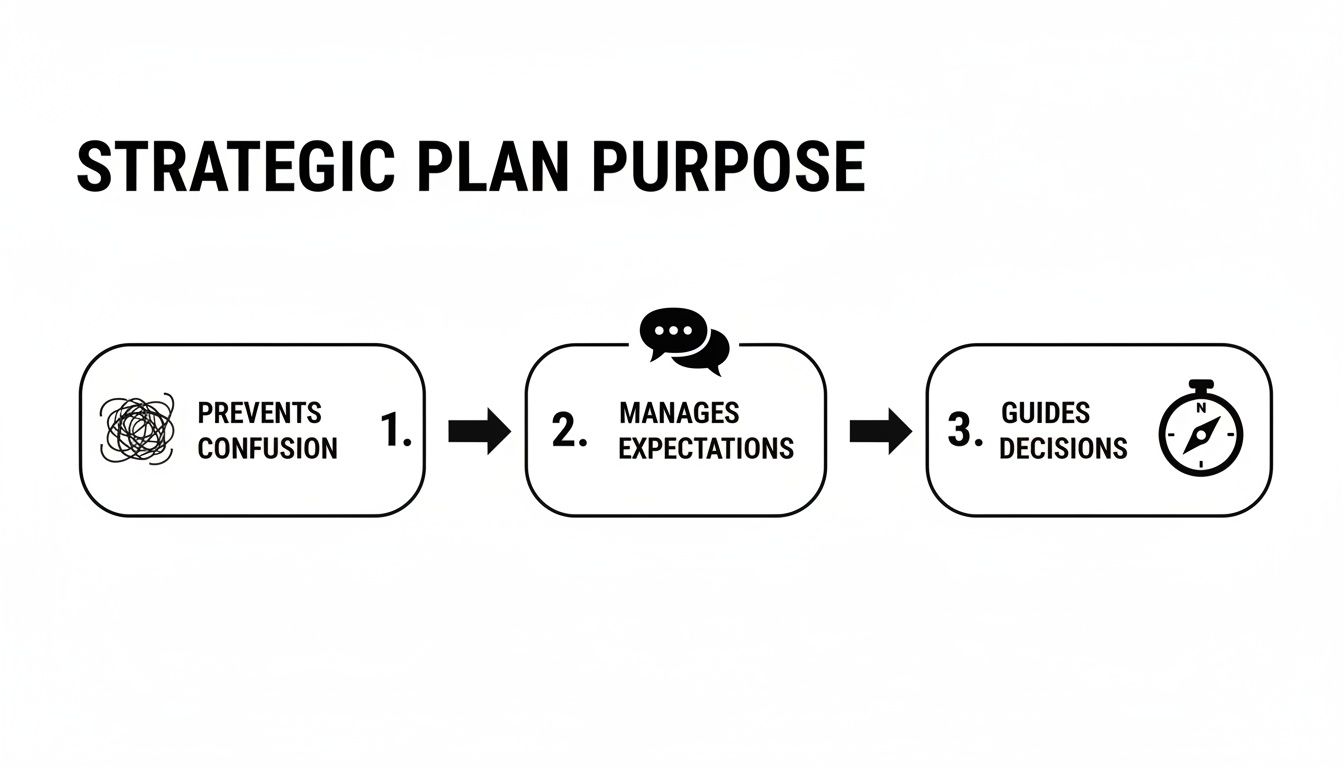
As the infographic shows, a strong plan isn't just about reacting to situations; it's a proactive tool designed to create genuine operational harmony.
Anticipating Challenges and Unlocking Opportunities
A truly effective plan doesn't just map out what to say—it anticipates roadblocks and uncovers hidden opportunities.
For example, any modern communication plan has to acknowledge the digital divide. While it’s true that an estimated 67% of the global population had internet access in 2023, that still leaves 2.6 billion people offline. For organizations like non-profits or medical practices serving diverse communities, a digital-only strategy will inevitably miss people. A thoughtful plan must account for this by including offline channels like SMS notifications or printed flyers to ensure no one is left behind. You can dig deeper into these global connectivity trends in the ITU's 2023-2024 report.
By thinking strategically about who you need to reach and how they consume information, your plan becomes a powerful tool for inclusion and effectiveness. It stops being about broadcasting messages and starts being about building genuine connections.
This kind of foresight allows you to build a more resilient communication ecosystem. You can head off potential misunderstandings, prepare messaging for different scenarios, and get your entire team aligned on the same narrative. That alignment is the secret sauce—it turns every email, meeting, and update into an opportunity to strengthen relationships and move your mission forward with confidence.
Defining Your Goals and Understanding Your Audience
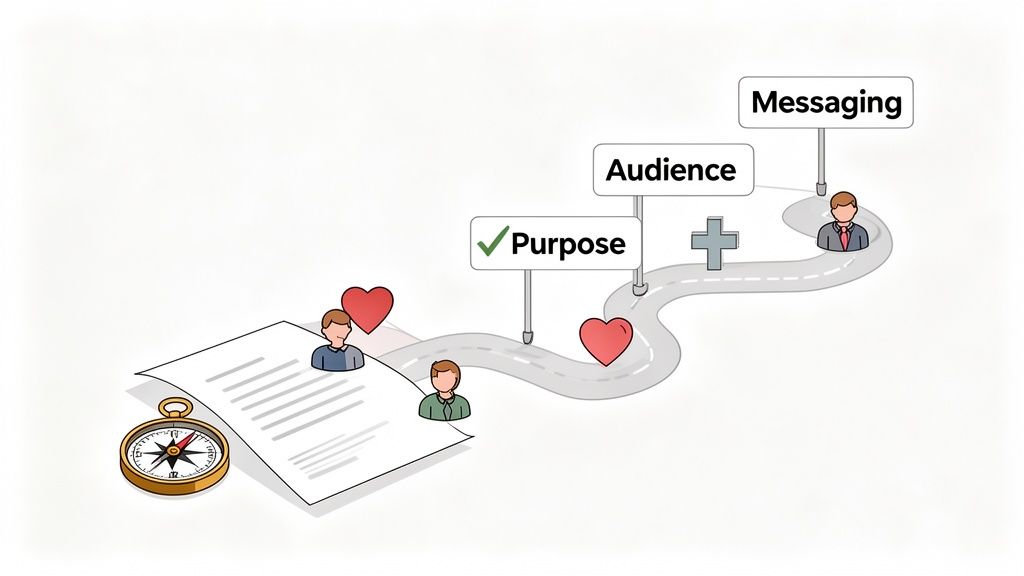
Before you write a single word or send one email, every solid communication plan starts by answering two simple but powerful questions: "Why are we even doing this?" and "Who are we talking to?"
Getting crystal clear on these two points is what separates a plan that actually drives results from a bunch of random, disconnected messages that just add to the noise. If you skip this step, you're essentially setting sail without a destination. You might be busy, but you won't be making any real progress.
Setting Meaningful Communication Objectives
Let’s get one thing straight: vague goals like "improve communication" are useless. Your objectives have to be specific, measurable, and tied directly to a tangible business outcome. This is where you prove that your communication efforts deliver real value, which is a key part of learning how to create a communication plan that gets leadership buy-in.
Think about the difference here.
-
Instead of a vague goal like "Keep donors informed," you create an actionable objective: "Increase monthly recurring donations by 15% within six months by sending targeted impact reports to past one-time donors."
-
Instead of "Improve patient experience," your objective becomes: "Reduce patient no-shows by 25% over the next quarter by implementing a multi-channel (SMS and email) appointment reminder system."
The difference is accountability. An actionable objective gives you a clear target to aim for and a metric to measure your success against. It transforms communication from a cost center into a value-driver for the organization.
The SMART framework is your best friend here. It's a classic for a reason—it forces you to define your objectives with the clarity you need.
- Specific: What exactly do you want to accomplish?
- Measurable: How will you track progress and know you've won?
- Achievable: Is this goal realistic with the resources and time you have?
- Relevant: Does this actually support the organization's bigger goals?
- Time-bound: When does this need to be done?
Working through this process makes you think critically about what you want to achieve before you dive into the how.
Mapping Your Stakeholders and Audiences
Okay, so you know why you're communicating. Now, who are you talking to? A one-size-fits-all message just doesn't cut it. Different groups have different priorities, concerns, and levels of interest, and your message has to connect with them on their terms.
This is where stakeholder mapping comes into play. It’s simply a structured way to identify and prioritize all the people who have a stake in your project or organization. Start by brainstorming every possible individual or group, then begin to categorize them.
Primary, Secondary, and Tertiary Audiences
A straightforward way to organize your audiences is to group them into three tiers. Doing this helps you decide where to focus your energy and resources, ensuring you give the most attention to the groups that matter most.
-
Primary Audience: These are the people you absolutely must reach. Their action or approval is essential to hitting your objective. For a non-profit fundraiser, this is your list of major donors and potential corporate sponsors.
-
Secondary Audience: This group has a strong influence over your primary audience, even if they aren't the final decision-makers. Think board members, community leaders, or volunteers who can become powerful advocates for your cause.
-
Tertiary Audience: These are the observers. They have a general interest but aren't directly involved. This might include local media, industry peers, or the general public. While they aren't your main focus, keeping them in the loop is great for managing your organization's reputation.
Let's imagine a med spa launching a new treatment:
| Audience Tier | Example Group | Key Interest |
|---|---|---|
| Primary | Existing loyal clients | Early access, exclusive discounts, benefits |
| Secondary | Influencers & local media | Newsworthy angles, expert insights |
| Tertiary | General local community | Brand awareness, general service info |
When you analyze your audiences this way, you can stop broadcasting generic messages and start having targeted, meaningful conversations. Understanding what each group truly cares about lets you craft messages that resonate, answer their questions, and ultimately drive the action you need.
Crafting Your Message and Selecting the Right Channels
Okay, you’ve defined your objectives and mapped out your audience. Now comes the fun part: figuring out what to say and where to say it. This is the moment your strategy starts to feel real. Getting your messaging and channels right is the difference between communication that gets noticed and communication that gets results.
A classic mistake I see all the time is jumping straight into tactics—blasting out emails or throwing up social media posts without a clear, unifying message. That’s a recipe for confusion. What you need first is a simple messaging hierarchy to keep everyone, from the CEO to the front desk, singing from the same hymn sheet.
Developing Your Core Message and Proof Points
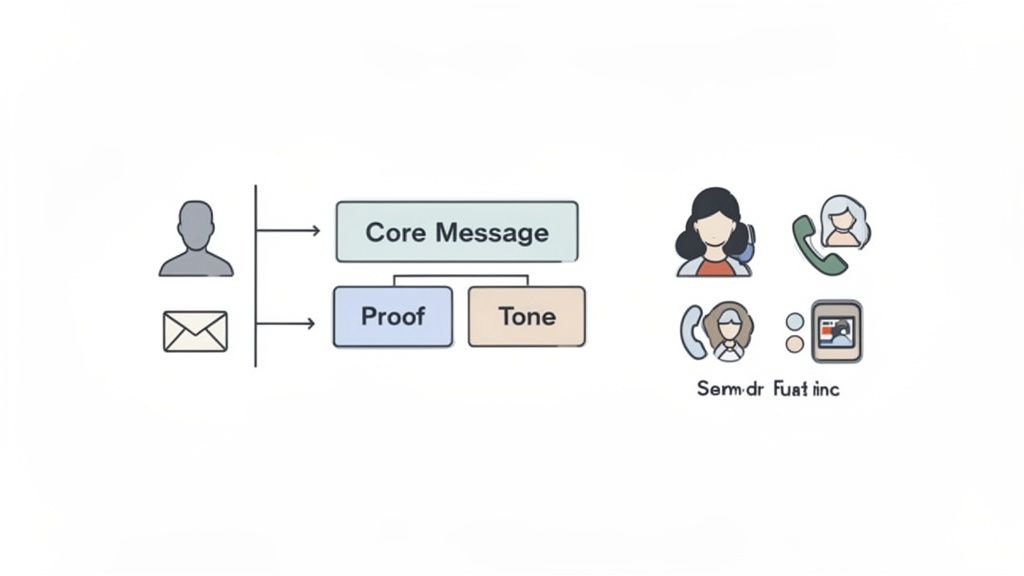
Your core message is the one big idea you need your audience to walk away with. It should be short, memorable, and tied directly to your goals. Think of it as the headline for your entire campaign.
Once you’ve nailed that down, you need to back it up with proof points. These are the facts, stories, and data that make your message believable. People need to see the evidence.
-
Core Message: This is your central theme. For a medical practice launching a new patient portal, a great core message would be: "Our new patient portal gives you secure, 24/7 access to your health information, making it easier than ever to manage your care."
-
Supporting Proof Points: This is your evidence. For that same patient portal, your proof points might look like this:
- Fact: "You can now request prescription refills online in under two minutes."
- Benefit: "View your lab results the moment they’re available, without waiting for a call."
- Story: "One of our beta testers, Jane D., was able to schedule an urgent appointment for her son at 10 PM right from her phone."
This simple structure creates incredible consistency. It doesn't matter who is talking or what channel they're using; the core idea always shines through.
A solid messaging framework is your North Star. It ensures every tweet, email, and conversation reinforces your central idea, building momentum with every single interaction.
Choosing the Right Channels for Your Audience
With your messages ready to go, it's time to decide how to get them out there. The goal isn’t to be everywhere at once; it's to be in the right places where your audience is already listening. A brilliant message sent through the wrong channel is just noise.
This is where a channel matrix comes in handy. It forces you to think strategically about where you show up and why, instead of just defaulting to what you've always done.
The Strategic Channel Matrix
Think through your options using a framework like this.
| Channel | Best For | Audience Example | Real-World Scenario |
|---|---|---|---|
| Email Newsletter | Detailed updates, storytelling, and directing traffic to resources. | Donors of a non-profit who have opted-in for updates. | Sending a quarterly impact report with success stories and a clear call-to-action to donate. |
| Internal Platform (OpsHub/Slack) | Quick announcements, team collaboration, and real-time updates. | Internal staff and volunteers at a non-profit. | Announcing a last-minute change to a volunteer schedule using a dedicated channel in OpsHub. |
| SMS/Text Message | Urgent alerts, appointment reminders, and time-sensitive info. | Patients of a medical spa or medical practice. | Sending an automated reminder 24 hours before a scheduled appointment to reduce no-shows. |
| Social Media | Building community, sharing visual content, and raising broad awareness. | Potential new clients for a med spa or supporters for a non-profit. | Sharing before-and-after photos of a new treatment or a short video from a successful community event. |
| In-Person Meetings | Complex discussions, sensitive topics, and building deep relationships. | Major donors, key stakeholders, or your internal leadership team. | Presenting a new strategic direction to the board or having a one-on-one with a top donor to secure a major gift. |
This approach helps you build a communication ecosystem where every channel has a purpose. They should work together, not in silos. For instance, a social media post might raise awareness about your non-profit’s annual fundraiser, driving people to an email sign-up. The email then nurtures those new contacts with powerful stories, eventually directing them to a donation page.
Matching your message and audience to the most effective channels is a non-negotiable step in learning how to create a communication plan that actually moves the needle.
Bringing Your Plan to Life: The Action and Measurement Framework
Strategy is one thing, but execution is where the rubber really meets the road. This is the point where all those carefully crafted goals, audience maps, and messages transform from abstract ideas into a concrete schedule of activities with clear owners. A brilliant strategy is useless if it just collects dust on a shelf.
The real aim here is to build a living document that guides your team's day-to-day work. For every single communication activity, everyone should know the answer to three questions: Who is doing this? When is it due? And what do they need to get it done?
This framework is what turns your plan from a static document into a practical playbook for success.
Building Your Communication Calendar
Think of your communication calendar as the tactical heart of your entire plan. It's the detailed schedule mapping out every single email, social media post, internal meeting, or press release. This isn't a 30,000-foot view; it’s a granular timeline that brings clarity to your team and stops those last-minute scrambles for content.
A truly useful calendar should always include:
- Key Dates and Milestones: Major events like product launches, fundraising campaigns, or important deadlines.
- Specific Activities: The exact tactic, like "Draft Q3 donor newsletter" or "Post patient success story on Instagram."
- Assigned Owner: The one person who is ultimately on the hook for getting that task across the finish line.
- Due Dates: Firm deadlines for drafts, approvals, and the final "go-live" date.
- Status: A simple tracker (e.g., Not Started, In Progress, Complete) so everyone is on the same page at a glance.
Frankly, this is where many teams stumble. The Global CommTech Report 2023 uncovered a huge disconnect: while 56% of comms pros feel highly competent with their tech, a shocking 47% don't use any project management software. Even more, 41% are still stuck using basic spreadsheets.
This just underscores the need to move beyond siloed tools. An integrated platform like OpsHub can turn your calendar into a dynamic, automated workflow instead of just another static spreadsheet to be ignored.
Defining Roles and Responsibilities
Nothing kills momentum faster than ambiguity. When people don't know who is supposed to do what, tasks get dropped, work gets duplicated, and frustration mounts. To prevent this, you need to clearly define everyone's role. A simple RACI chart (Responsible, Accountable, Consulted, Informed) works wonders here.
- Responsible: The person actually doing the work (e.g., the grant writer who drafts the foundation update).
- Accountable: The person who owns the outcome and gives the final approval (e.g., the Director of Development).
- Consulted: The subject matter experts you need input from (e.g., a Program Manager who provides the latest impact data).
- Informed: People who just need to be kept in the loop (e.g., the Board of Directors).
Documenting roles this way removes confusion and empowers your team to move forward with confidence.
Establishing a Measurement Framework
So, how will you know if any of this is actually working? A solid measurement framework isn't a "nice-to-have"—it's non-negotiable. This means getting past feel-good "vanity metrics" like social media likes and honing in on Key Performance Indicators (KPIs) tied directly to your business objectives.
Your measurement strategy shouldn't just be about proving the value of your work. It's about informing your next move. The goal is to create a continuous feedback loop, allowing you to constantly refine and improve your plan over time.
Instead of just tracking superficial numbers, you need to focus on metrics that show genuine impact.
| Vague "Vanity" Metric | Meaningful KPI |
|---|---|
| Email Open Rate | Click-Through Rate on the "Donate Now" button |
| Website Page Views | Time on Page for your most important service pages |
| Social Media Followers | Engagement Rate on posts asking for volunteer sign-ups |
| Number of Newsletters Sent | Conversion Rate of readers who actually book an appointment |
These are the KPIs that give you actionable intelligence. A low click-through rate on your "Donate Now" button tells you the call-to-action isn't compelling enough. Low engagement on volunteer posts might signal that you're fishing in the wrong pond (i.e., using the wrong channel).
By building in these feedback mechanisms—whether it's through analytics, surveys, or just talking to people—you ensure your communication plan is a living, breathing tool that evolves with your organization. This cycle of executing, measuring, and refining is what separates a good plan from a truly great one.
7. Turn Your Plan into Action with Automation and AI
A great communication plan is more than just a document—it's a living, breathing part of your operations that needs consistent, flawless execution. This is where so many strategies fall flat. The good news is, you don't have to run it all manually. Modern tools can turn your carefully crafted plan into a smooth, automated workflow.
Instead of getting bogged down tracking tasks in spreadsheets or chasing people with reminder emails, an AI-powered operations platform can be the engine that drives your entire plan. By bringing your tasks, timelines, and messaging into one central hub, you create a single source of truth. This slashes administrative busywork and dramatically reduces the chance of human error.
Weave Your Plan into Daily Workflows
Imagine your communication calendar is directly wired into your team’s daily work. When a deadline for the "Q2 Donor Newsletter" is approaching, the person responsible automatically gets a ping in Slack. That notification doesn't just say "it's due"—it includes all the necessary briefing documents and key message points right there. That's the power of a truly connected system.
Platforms like OpsHub are built to do just this. They link the different software you already rely on, like Google Workspace and internal chat tools, creating a seamless operational flow. This ensures every piece of your communication plan gets done with precision, right inside the tools your team already has open all day.
This approach is also a game-changer when you're fighting for resources. We all know budgeting is a constant challenge. A 2023 Edelman study found that while 73% of leaders expect budget shifts, 30% are bracing for cuts. The problem is compounded by the fact that 44% of Chief Communication Officers feel their CEOs just don't understand the resources required to execute properly.
By using automation, you can track progress and show a clear return on your efforts, making it much easier to justify your budget. You can dig into all the findings on corporate communications here.
How Automation Looks in the Real World
Let's move from theory to practice. Here’s how this works for different kinds of organizations.
-
For a Non-Profit: A non-profit can build an automated donor update sequence in OpsHub. Once a big fundraising campaign wraps up, the system automatically kicks off a series of tasks. It assigns the grant writer to draft an impact report, schedules a review meeting for the director, and then queues up a personalized email blast to every single campaign donor.
-
For a Medical Spa: A med spa can automate its entire patient communication flow to slash no-shows and keep clients engaged. The system can send out appointment reminders via both SMS and email 48 and 24 hours before a booking. After the appointment, another automation can trigger a follow-up email asking the client to leave a review. All of this happens without the front desk staff lifting a finger.
The real win here is freedom. By turning repetitive manual processes into automated workflows, you give your team the bandwidth to focus on high-value, strategic work instead of getting lost in administrative quicksand. This is how you scale your impact without scaling your payroll.
The difference between a manual approach and an automated one is night and day. Take a look at how an integrated platform transforms the day-to-day work of running a communication plan.
Manual vs. Automated Communication Plan Execution
| Communication Task | Manual Approach | Automated with OpsHub |
|---|---|---|
| Task Assignment | Sending emails or Slack messages to assign tasks. It's easy for details and deadlines to get lost in the shuffle. | Tasks are automatically assigned based on the calendar, with all the necessary context and files attached from the start. |
| Progress Tracking | Constantly asking for updates and manually checking off items in a spreadsheet that's probably already outdated. | Real-time dashboards give you a bird's-eye view of every communication task, so you always know what's on track and what's not. |
| Recurring Messages | Relies on someone remembering to send out the monthly newsletter or weekly team reminders. Things inevitably fall through the cracks. | "Set it and forget it" automations handle all recurring communications perfectly on schedule, every time. |
At the end of the day, building automation and AI into your process is a critical part of learning how to create a communication plan that's both brilliant and built to last. It’s what ensures your strategy doesn't just look good on paper, but actually gets executed flawlessly.
Got Questions? Let's Talk Strategy
Even with the best guide in hand, moving from theory to reality always brings up new questions. When you start building your own communication plan, you'll inevitably run into specific challenges that need a quick, clear answer. This section is all about tackling those common hurdles head-on.
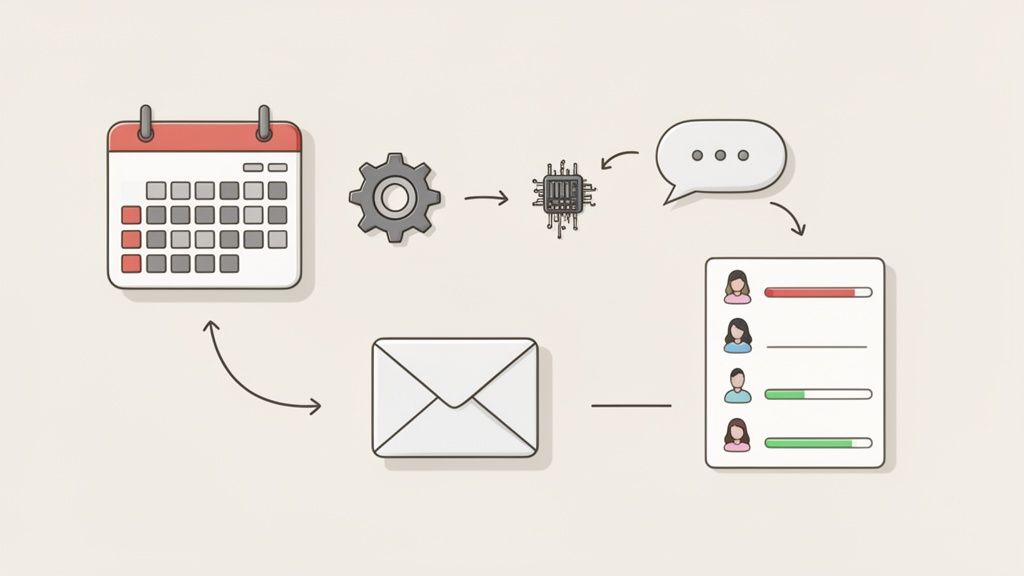
I've gathered the most frequent questions I hear from teams, from figuring out how to keep things simple to getting that crucial sign-off from leadership.
What Should a Simple Communication Plan Include?
Look, not every initiative needs a 50-page binder. For smaller projects or teams just getting their feet wet, a stripped-down, one-page plan is way more effective. Why? Because people will actually use it.
A lean plan still needs to cover the basics to keep everyone on the same page. Make sure it answers these core questions:
- What’s our number one goal? Define the single, measurable outcome you're aiming for.
- Who are we really talking to? Name the primary audience you absolutely have to reach.
- What are our three key messages? Settle on one main idea and two supporting points. Keep it simple.
- How will we reach them? List the main channels you'll use (e.g., weekly email, all-hands meeting).
- Who owns what? Assign clear responsibility for the handful of critical tasks.
A simple plan isn’t a sloppy one. It's about focusing your effort where it delivers the most impact. A clear, concise plan that gets used is always better than a comprehensive one that collects dust on a shelf.
How Often Should I Update My Communication Plan?
A communication plan is a living document, not a stone tablet. The whole "set it and forget it" mentality is a recipe for failure. How often you revisit it really depends on the project's scope and pace.
For general, ongoing internal or external comms, a quarterly review is a great rhythm. It’s your chance to check the KPIs, tweak messaging based on what you’re hearing, and make sure your plan still lines up with the big-picture business goals.
For specific campaigns with a clear start and end—like a product launch or a fundraising drive—your approach needs to be more agile.
- Before Kick-off: The plan gets built and approved before a single email is sent.
- Weekly Pulse-Checks: During the project, quick weekly huddles are perfect for tracking progress against your calendar and making small course corrections on the fly.
- Post-Project Debrief: Once it's all over, run a proper retro. Dig into what worked, what flopped, and capture those lessons for next time.
Checking in regularly ensures your plan stays relevant and powerful, helping you adapt to reality instead of clinging to an outdated map.
How Do I Get Leadership to Buy Into the Plan?
Getting leadership on board is often the make-or-break moment. Without their backing, you won't get the budget, time, or authority to make things happen. The secret is to frame your plan not as a to-do list, but as a direct solution to their biggest headaches.
When you make your pitch, don't open with tactics like, "We need to send more newsletters." Instead, connect your work to the outcomes they actually care about.
- Tie It to Business Goals: Show a direct line between your communication efforts and a top-level priority. For example, "This plan is designed to reduce patient no-shows by 25%, which will directly lift clinic revenue."
- Bring the Data: Use past performance metrics or industry benchmarks to frame the problem. "Our employee engagement in the engineering department is 15% lower than the company average. This internal comms plan is built to close that gap."
- Quantify the "Ask": Be upfront about the budget and people you need. It shows you’ve done your homework and respect their role in managing company resources.
- Show the Risk of Doing Nothing: Gently highlight the consequences of weak communication. Think project delays, sinking morale, or a hit to your organization's reputation.
When you speak their language—the language of results, data, and risk—you elevate your request from a simple departmental need into a strategic business imperative they can't ignore.
Ready to turn your strategic plan into a seamless, automated reality? OpsHub is the AI-powered operations platform that unifies your workflows, tasks, and data into one calm command center. Stop chasing updates and start executing with precision by visiting us at https://signal.opshub.me.
Share This Story, Choose Your Platform!
TUNE IN

OpsHub Signal publishes analysis, essays, and field notes on operations, capital, policy, and systems design. Subscribe to receive a weekly briefing that cuts through noise and delivers what actually matters to operators.