

Data-driven decision making (DDDM) is the practice of using facts, metrics, and data to guide strategic business choices. It’s about moving away from relying purely on intuition, opinions, or anecdotal evidence.
Instead of making gut-feel calls, you're using operational data as a compass to find a clear path to growth. It's how smart organizations turn their day-to-day information into a genuine competitive advantage.
Understanding What Data Driven Decision Making Really Means
At its heart, data-driven decision making is a mindset that reframes big challenges as solvable puzzles. Rather than letting tradition or a senior leader's personal experience dictate the next move, teams use tangible evidence to steer the ship.
This approach does more than just improve outcomes; it cuts down on internal debates and aligns everyone around objective goals. When the data points the way, it's easier to ensure every major decision is directly tied to improving the bottom line.
Think of it like a ship's captain. The old-school captain might navigate by the feel of the wind and the look of the clouds—and they might get it right occasionally. But the data-driven captain uses radar, sonar, and detailed weather charts. They plot the most efficient and safest course, avoiding hidden dangers and catching favorable currents. That’s exactly what DDDM does for your organization.
The Shift From Gut-Feel to Evidence-Based Strategy
This pivot toward evidence isn't just a fleeting trend—it's a fundamental change in how successful organizations work. The numbers back this up. An MIT Sloan study found that nearly 70% of companies now base most or all of their strategic decisions on data.
And it pays off. Research from McKinsey shows that data-driven organizations are 23 times more likely to acquire customers and 19 times more likely to be profitable. You can dig deeper into how companies leverage data on Atlan.com.
To really see the difference, it helps to put the two approaches side-by-side.
Traditional vs Data Driven Decision Making
The table below breaks down the shift from an intuition-led model to one grounded in evidence.
| Aspect | Traditional Approach (Gut-Feel) | Data Driven Approach (Evidence-Based) |
|---|---|---|
| Foundation | Relies on experience, intuition, and anecdotal evidence. | Based on verified data, metrics, and statistical analysis. |
| Process | Decisions are often reactive, subjective, and inconsistent. | Choices are proactive, objective, and follow a repeatable process. |
| Tools | Primarily uses personal observation and past successes. | Employs dashboards, analytics platforms, and CRM reports. |
| Outcomes | Results can be unpredictable and difficult to measure or justify. | Outcomes are measurable, justifiable, and optimized over time. |
What this comparison really highlights is a single, crucial element: control. Intuition is a powerful asset, but it becomes unstoppable when validated by data.
DDDM gives you a reliable framework to test your assumptions, confirm your insights, and build a strategy that delivers measurable results, time and time again. It’s also why understanding foundational concepts like what is systems integration is so critical—you need a unified data environment to make any of this work.
How Data-Driven Decisions Forge a Competitive Edge
Making the switch to a data-driven approach is like upgrading from a dusty, hand-drawn map to a live, high-resolution satellite feed. It replaces guesswork and intuition with objective, quantifiable evidence, giving you the clarity and precision to navigate crowded markets and outpace the competition.
This isn't just about hoarding numbers. It's about turning those numbers into intelligent action. When your decisions are grounded in solid data, you can move faster, allocate your resources with confidence, and adapt to market shifts before they become problems.
Turning Insights into Measurable Growth
The real magic happens when data directly shapes your growth strategy. It draws a straight line from analysis to results, influencing everything from the first customer touchpoint to their long-term loyalty.
Instead of your team debating which marketing channel feels like the best bet, you can pinpoint precisely which ones deliver the highest return. This lets you double down on your winners and cut the losers, stretching every dollar for maximum impact.
The results of this evidence-based strategy speak for themselves. According to extensive research from McKinsey, data-driven organizations are 23 times more likely to acquire new customers and 6 times more effective at keeping them. For midsize businesses, the advantage is even clearer: companies driven by customer insights grow 2.5 times faster than their peers.
Building an Advantage Your Competitors Can't Copy
A competitive advantage built on data is incredibly hard to replicate. A rival can copy your product features or mimic your ad campaigns, but they can't easily duplicate the deep, data-backed understanding you have of your own customers and operations.
Data provides a cumulative advantage. The more you learn from it, the smarter your decisions become, creating a cycle of continuous improvement that leaves less agile competitors struggling to catch up.
This virtuous cycle strengthens the core functions that secure your place in the market:
- Smarter Customer Acquisition: By analyzing where your best leads come from and how they convert, you can build a crystal-clear profile of your ideal customer. This allows you to focus your efforts on attracting more of them, which naturally lowers your acquisition costs.
- Deeper Customer Retention: Data shows you why customers stick around and what makes them leave. By tracking behavior and feedback, you can proactively solve problems, personalize their experience, and build the kind of loyalty that keeps churn low.
- Higher Profitability: From optimizing your supply chain to fine-tuning your sales funnel, data helps you trim waste and uncover new revenue streams, boosting your bottom line directly.
Making Data a Part of Your Daily Operations
The ultimate goal is to weave data into the fabric of your organization. This means embedding insights into automated workflows and smarter processes that don't require constant human intervention.
Think about a common challenge like sales follow-up. Instead of relying on a salesperson's memory, a data-driven system can automatically trigger a personalized email based on a prospect's specific actions. No more missed opportunities.
An operations team can use the same principle, using real-time performance data to spot bottlenecks and shift resources before a minor hiccup becomes a full-blown crisis. This is how data moves off a dashboard and becomes a living, breathing part of your company's success—and it's what separates a good organization from a dominant one.
A Practical Framework for Making Data-Driven Choices
Shifting to a data-driven culture doesn’t require a team of data scientists. It comes down to a simple, repeatable framework that turns information you already have into your best asset. This process breaks the work into four clear, manageable stages that anyone on your team can follow.
The whole point is to move from staring at overwhelming spreadsheets to finding clear, actionable answers. This is also the foundation for building a modern data driven marketing strategy.
This diagram shows how data feeds directly into the customer lifecycle, turning raw information into a real competitive advantage.
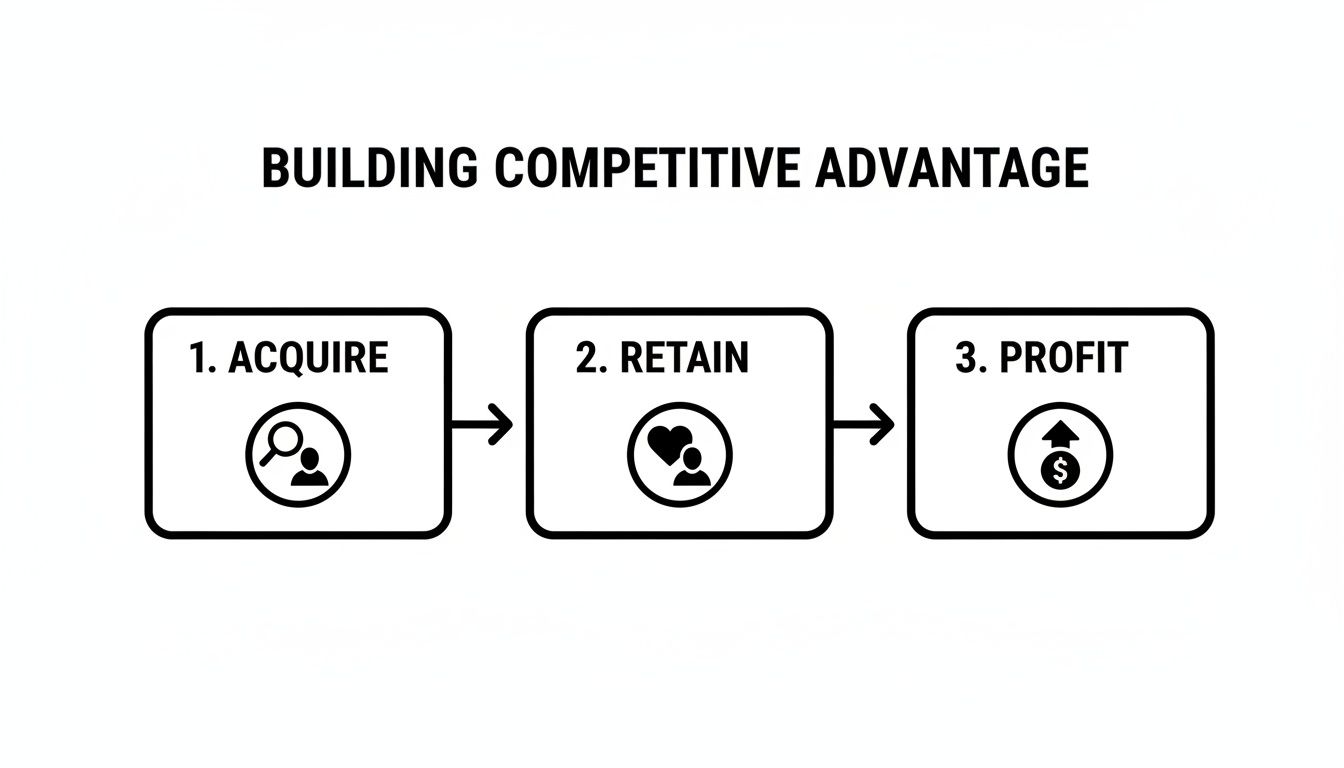
Each stage—Acquire, Retain, and Profit—gets stronger when it's backed by evidence, making sure your time and money are spent on what actually works.
Stage 1: Define Your Most Critical Questions
The entire process starts with one specific, high-value business question—not with data. Before you open a spreadsheet, you must know what problem you’re trying to solve. Kicking things off with a focused question anchors your efforts and keeps you from getting lost in irrelevant information.
Your questions should be pointed and tied directly to an operational goal.
- For an operations team: "Which specific step in our fulfillment process is causing the longest delays?"
- For a non-profit: "Of all our outreach campaigns last quarter, which one brought in the most new recurring donors?"
- For a small medical practice: "What's the average patient wait time between check-in and seeing a doctor, and how does that number affect their satisfaction scores?"
These kinds of questions give your data a job to do, turning it from background noise into a tool for targeted problem-solving.
Stage 2: Gather the Right Data
Once you have a clear question, the next step is to find and collect the data that holds the answer. You probably already have most of what you need sitting in different places—your CRM, accounting software, project management tools, or even simple spreadsheets.
The trick is to focus only on the data relevant to your question. If you’re hunting for operational bottlenecks, you need timestamps from your workflow system, not your website's traffic stats. This targeted approach makes the process faster and a whole lot less intimidating. You might also want to explore a guide on small business workflow management software to see how the right tools can make this step much easier.
Stage 3: Analyze for Actionable Insights
This is where raw data transforms into actual knowledge. You don't need complex statistical models here; often, the most powerful insights come from simple analysis. Just look for patterns, trends, and outliers that directly answer the question you started with.
An insight is more than just an observation—it’s a discovery that demands action. "Sales are down 10%" is an observation. "Sales are down 10% specifically for customers who didn't receive a follow-up email" is an actionable insight.
For a non-profit, this could be discovering that donors who open your newsletter are 50% more likely to donate again. For an operations team, it might be finding that 75% of delays all happen at a single handover point between two departments. This is the "aha!" moment that tells you exactly what to do next.
Stage 4: Implement, Measure, and Repeat
The final stage is all about closing the loop. You take your newfound insight and implement a change based on it. That might mean launching a targeted email campaign to your most engaged donors or redesigning a workflow to eliminate that bottleneck you found.
But you're not done just yet. You have to track the results of your change using the same metrics you started with. Did wait times go down? Did recurring donations go up? This feedback loop is what drives continuous improvement and truly builds a data-driven culture.
The impact here is huge. Industry leaders report a 63% productivity boost in operations after adopting this kind of model, while marketing teams see 28% faster revenue growth. Globally, 64% of companies now have dedicated data-driven strategies, which has helped them cut marketing waste by 21%. This iterative cycle ensures every decision makes your organization a little bit smarter and more efficient than it was before.
Overcoming the Roadblocks to a Data-Driven Culture
Making the switch to data-driven decision-making isn't just about buying new software. It’s about changing how people think and work together. While the payoff is huge, the path is often blocked by common organizational hurdles. To make this transition stick, you have to meet these challenges head-on.
The most common roadblocks aren't technical; they're human. We're talking about siloed information, a deep-seated resistance to change, and general confusion over who even owns the data. Getting ahead of these issues is the key to avoiding a stalled-out initiative.
Dismantling Stubborn Data Silos
One of the biggest killers of smart decisions is the data silo. This happens when valuable information gets locked away within individual departments. Marketing has its numbers, sales has theirs, and operations is looking at a completely different set of metrics. When nobody has the full picture, true data-driven decisions are impossible.
Think of it like trying to solve a puzzle, but each person at the table only has a few random pieces and won't share. You'll never see the final image. Tearing down these walls is the first, most critical step.
Here are a few practical actions to take:
- Create Cross-Functional Teams: Pull together small groups with people from different departments to solve one specific problem. When you get sales and marketing to collaborate on a lead-generation project, they're forced to share data and start building a unified view.
- Establish a "Single Source of Truth": Pick one primary place for a specific type of data and stick to it. For example, all customer contact information must live in the CRM—not in a dozen different spreadsheets. This simple rule prevents so much confusion and gets everyone working from the same playbook.
The goal isn't just to connect systems; it's to connect people. When teams see how sharing data helps them hit their own goals faster, the silos naturally begin to crumble.
Overcoming Cultural Resistance to Change
Even with perfect data, you'll face pushback if your team is used to running on gut feelings and "the way we've always done it." People often worry that data will make their experience irrelevant or shine a spotlight on performance gaps. It’s a completely natural human reaction, and you have to handle it with empathy and a good strategy.
You can't just announce, “We’re data-driven now.” You have to show people how it helps them directly. This is where small, visible wins become your most powerful tool.
- Launch High-Impact Pilot Projects: Don't try to boil the ocean by changing the whole company at once. Find one motivated team and give them a small, well-defined problem to solve with data. For instance, have your customer service team analyze feedback to find the single most common complaint and then empower them to fix it.
- Celebrate the Wins Publicly: When that pilot project works, shout it from the rooftops. Show everyone how the team used data to cut customer complaints by 30%. This offers concrete proof that the new approach works and, more importantly, makes other teams want in on the action.
This process builds momentum on its own. Success quiets the skeptics and can even turn your biggest resistors into your new champions. Managing this change carefully is also vital for your team's health; you can learn more in our guide on how to prevent employee burnout when introducing new ways of working.
How AI and Automation Amplify Your Decision Making Power
Being data-driven is great, but it often means analyzing what’s already happened. When you bring Artificial Intelligence (AI) and automation into the mix, you’re no longer just looking in the rearview mirror—you can start predicting what's coming next.
This isn't about replacing your team's hard-won experience. It's about giving them a co-pilot that can see around corners.
Think of it as giving your operations team an assistant that never sleeps, gets bored, or makes a mistake. This AI-powered helper can watch all your data streams at once, spot tiny warning signs before they become big problems, and even suggest the best path forward based on what it predicts will happen next. This frees up your leaders from the daily grind of monitoring data so they can focus on strategy and growth.

From Reactive Analysis to Proactive Strategy
The real advantage of AI in a data-driven model is its ability to spot patterns humans would almost certainly miss. It can sift through thousands of variables at once to forecast market shifts, anticipate what a customer might do next, or find hidden bottlenecks in your workflow.
This lets you shift from a reactive mode—fixing problems as they pop up—to a proactive one. Instead of just figuring out why you lost donors last quarter, AI can tell you which supporters are most likely to churn next month. That gives you a crucial window to step in with the right message and keep them engaged.
Turning Complexity into a Strategic Asset
For most organizations, operational complexity is a headache. But with AI-powered automation, that complexity becomes your secret weapon. You can build custom workflows that take care of all the repetitive, time-consuming tasks that drain your team's energy.
Here are a few practical examples of how this works:
- Automated Administrative Tasks: Imagine AI handling appointment scheduling, invoice processing, or routine data entry. This can easily free up dozens of hours a week for work that actually moves the needle.
- Streamlined Sales Pipelines: Automation can instantly sort new leads, send them to the right person, and kick off a personalized follow-up campaign. No more great opportunities falling through the cracks.
- Intelligent Reporting: Forget spending hours building reports. AI can create real-time dashboards that give every stakeholder the exact insights they need, right when they need them.
To see just how much these tools can change the game, it's worth exploring the real-world benefits of AI in customer service. The whole point is to build systems that hum along reliably and intelligently in the background.
By automating the predictable, you empower your team to excel at the exceptional. AI handles the number-crunching and monitoring, so your people can focus on what they do best: building relationships, solving tough problems, and driving growth.
This approach makes sophisticated data analysis something everyone can use, not just the data scientists. Platforms like OpsHub are built to drop these custom, AI-powered workflows right into your existing systems. This allows your team to tap into the full potential of automation without needing a degree in machine learning. You can explore a ton of different intelligent automation use cases to see how this works in the real world, turning your operational data into a powerful engine for success.
Your First Steps to Becoming a Data-Driven Organization
Making the shift to a data-driven approach doesn't require tearing down your current operations. In fact, the most successful transitions always start small. They focus on intentional, manageable steps that build momentum over time.
Think of it as an ongoing process, not a one-time project. The secret is to score a few early wins that get everyone excited and prove the value of this new way of thinking. This final section lays out a practical plan you can start on today, focusing on high-impact steps that don't require a huge budget.
Start with a Single, Focused Question
Your first instinct might be to go out and collect a mountain of new data. Resist that urge. The real first step is to ask a better question. Instead of trying to boil the ocean, pinpoint one specific, nagging business problem you need to solve right now.
A good starting question is precise and directly connected to a result you can measure. For example, rather than a vague goal like, "How can we improve sales?" get specific: "Which of our marketing channels generated leads with the highest conversion rate last quarter?" This simple change gives your efforts immediate direction and a clear finish line.
The goal here is to find an answer that delivers tangible value, fast. When you solve one focused problem with data, you create a powerful proof-of-concept. It's the best way to quiet the skeptics and build genuine enthusiasm for what’s next.
Audit the Information You Already Have
With your question in hand, it's time to look at the data you've already got. You’d be surprised how much useful information is sitting right under your nose, even if it's scattered across your CRM, accounting software, or various project management tools.
Just create a simple checklist. What specific data points do you need to answer your question? Now, where does each one live? This quick audit doesn't have to be perfect; it's just about gathering the puzzle pieces you need to solve this one problem. It will immediately show you where your information is solid and where you might have some gaps.
Empower a Small Team for a Pilot Project
Now, it's time for action. Pull together a small, cross-functional team and empower them to run a pilot project. Give them the freedom to gather the data, dig into it, and present what they find. This small group will become your internal case study for what data-driven decision making looks like in the real world.
Here’s a simple roadmap you can give them:
- Define the Scope: Get crystal clear on the question they’re answering and give them a deadline (say, two weeks).
- Provide Access: Make sure the team can actually get to the data they identified in the audit. No roadblocks.
- Analyze and Conclude: The team’s job is to sift through the information, find the patterns, and come back with a clear conclusion that directly answers the original question.
- Recommend an Action: Based on what they learned, the team should propose one specific, actionable change to how you do things.
- Share the Results: Finally, have the team present their findings, their recommendation, and the impact they expect it to have.
Following this path turns the abstract idea of being "data-driven" into a concrete, repeatable process. By starting small and showing real value, you lay the groundwork for a culture where evidence, not just gut feeling, leads the way.
Frequently Asked Questions About Data-Driven Decision Making
Even with a solid plan, moving toward a data-driven approach always brings up some practical questions. Let's tackle a few of the most common ones that leaders ask when they're just getting started.
Where Should a Small Business Start with Data-Driven Decision Making?
If you're a small business, don't try to track everything at once. The best way to begin is by picking one critical area that really matters to your bottom line—think customer retention or sales conversion rates. Start by asking the single most important question you need an answer to in that area.
You don't need fancy tools right away, either. Use what you already have, like your CRM, accounting software, or even a simple spreadsheet, to pull together the necessary numbers. The goal here isn’t to boil the ocean; it’s to get a small, quick win that proves how valuable this way of thinking is. That initial success is what builds the momentum you need to keep going.
What Are the Most Important Metrics for an Operations Team to Track?
For an operations team, the focus should be squarely on metrics that measure three things: efficiency, cost, and quality. Tracking these KPIs gives you a clear, honest look at the health of your operations and points you directly to what needs fixing.
A few key examples include:
- Cycle Time: How long does it take to get something done from start to finish?
- Throughput: How many tasks or units are we completing in a given day, week, or month?
- Cost Per Unit: What’s the total cost to produce one widget or deliver one service?
- First Pass Yield: What percentage of our work gets done right the first time, with no rework needed?
These numbers give you a direct line of sight into how well your core processes are actually performing.
The most effective metrics are those that tie directly to both operational performance and financial outcomes. When you can show how reducing cycle time also lowers costs, the value of data becomes undeniable to everyone.
How Do You Build a Data-Driven Culture Without Data Scientists?
You don't need a team of Ph.D.s to build a data-driven culture. It really starts with leadership making data a visible and normal part of the daily conversation.
The real goal is to build data literacy—which is simply the ability to ask good questions and understand what the answers in the data are telling you. Start your meetings by reviewing a simple dashboard with a few key numbers. Encourage your team to back up their ideas with evidence by asking, "What data do we have to support that?"
And when a decision turns out well because it was based on good data, celebrate it. When you make data accessible and relevant to everyone’s job, you naturally create a culture of curiosity and evidence-based thinking. That's the true foundation for success.
Ready to turn complexity into your biggest advantage? OpsHub designs and operates custom AI-powered workflows that eliminate administrative drag and embed intelligent decision-making right into your operations. We handle the technical heavy lifting so your team can focus on growth.
Discover how OpsHub can build your operational co-pilot today.
Share This Story, Choose Your Platform!
TUNE IN

OpsHub Signal publishes analysis, essays, and field notes on operations, capital, policy, and systems design. Subscribe to receive a weekly briefing that cuts through noise and delivers what actually matters to operators.