

It's time for a reality check. Preventing burnout isn't about offering more yoga classes or wellness apps; it's about fundamentally redesigning the work itself. This guide provides an actionable, systemic approach that tackles the root causes head-on—from clunky workflows to administrative overload—to build an environment where your teams can succeed long-term.
The True Operational Cost of Employee Burnout
Let's be clear: employee burnout isn't just a wellness buzzword. It's a serious operational risk that quietly eats away at your bottom line. I've seen too many leaders dismiss it as a personal failing, a lack of resilience. But the truth is, burnout is almost always a symptom of something deeper—systemic friction, administrative overload, and broken processes.
Viewing burnout through this operational lens is the only way to solve it. When your best people are buried in repetitive tasks, manual data entry, and inefficient communication, you're not just wasting their time. You're draining their energy and creativity, which directly impacts your organization's ability to grow and innovate.
The Financial Drain of Inefficient Operations
The financial hit from burnout is staggering. The data paints a clear picture: burned-out employees lead to higher costs across the board. Gallup's recent findings show that 48% of employees worldwide feel the strain of burnout. For a midsize organization, that translates into very real losses. Think about it—a single unplanned absence can cost around $340 per day, and employees struggling with their mental health miss nearly 12 days of work a year. That’s a huge jump from the 2.5 days their healthier colleagues take.
Burned-out staff are also 2.6 times more likely to be looking for a new job. They take 63% more sick days. And they end up in the emergency room 23% more often. These aren't just numbers; they represent real people and real costs.
This infographic really drives home the direct expenses tied to a stressed-out workforce, from job hunting to healthcare.
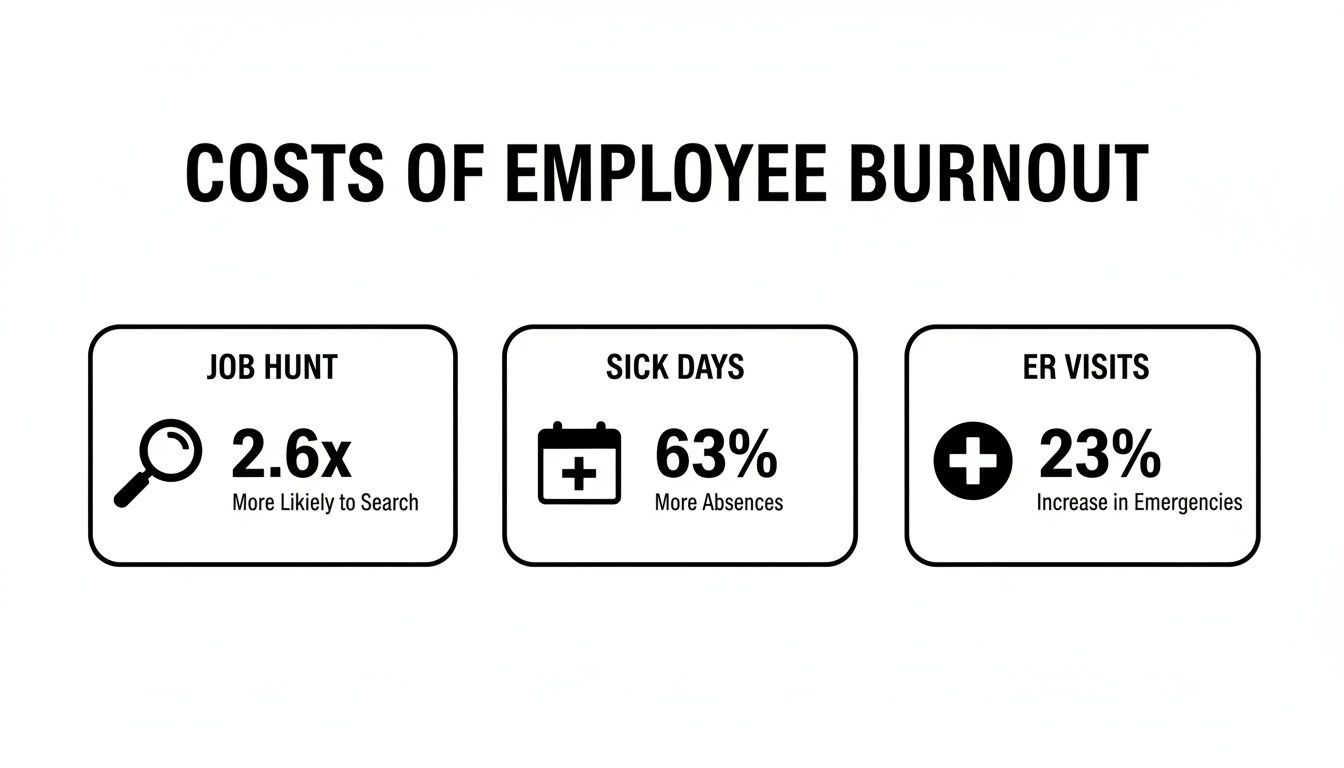
These metrics show that burnout isn't some fuzzy HR issue. It's a measurable risk that inflates your operational costs, plain and simple.
To put it in perspective, here’s how burnout directly impacts key business metrics.
Burnout's Impact on Key Business Metrics
This table summarizes the direct correlation between high burnout rates and negative business outcomes, quantifying the operational and financial risks.
| Business Metric | Impact of High Burnout Rates | Statistic/Source |
|---|---|---|
| Employee Turnover | Increased recruitment and training costs due to high attrition. | Burned-out employees are 2.6 times more likely to actively seek a different job. |
| Productivity & Output | Decreased efficiency and quality of work. | High burnout leads to a 13% decline in work quality. |
| Absenteeism | Higher costs from unplanned absences and lost workdays. | Burned-out employees take 63% more sick days. |
| Healthcare Costs | Increased insurance premiums and healthcare expenses. | Burned-out employees have 23% more emergency room visits. |
The data is clear. Ignoring burnout is not a viable strategy; it actively harms your operational health and financial stability.
Moving Beyond Perks to Process
Wellness programs are nice, but they don't fix the core problem. No amount of meditation can make up for a fundamentally broken process.
The most effective way to prevent burnout is to attack the systemic issues that cause it. By fixing the work itself, you create an environment where your team can thrive without sacrificing their well-being.
This means shifting your mindset from treating symptoms to solving root causes. Stop asking how to make your employees more resilient to stress. Instead, start asking practical, operational questions:
- Actionable Question: "Where are the administrative bottlenecks that are draining my team's energy? Is it the weekly sales report or the project approval process?"
- Actionable Question: "What specific manual, repetitive tasks can we automate? Can we set up a rule to auto-archive project emails or sync data between our CRM and our finance software?"
- Actionable Question: "How can we improve communication between departments to eliminate friction? Should we create a shared Slack channel for the marketing and sales teams for all new lead updates?"
Answering these questions is the first step toward building a culture of sustainable performance. To truly understand the financial side of this, digging into the real cost of employee burnout is essential. When you connect burnout prevention to tangible business outcomes, you can build a powerful case for investing in operational excellence. You can learn more about how to achieve this in our guide on operational excellence best practices.
Identifying the Early Warning Signs of Burnout
How do you spot burnout before it completely derails a project or a key team member? Waiting for the annual survey results is too late. Proactive recognition is about spotting the subtle, everyday clues that show a team is under unsustainable pressure.
Burnout rarely appears overnight. It’s a slow burn, creeping in through small changes in behavior and team dynamics. As a leader, your job is to catch these shifts before they become crises. This requires moving from a reactive "what happened?" stance to a proactive "what's happening?" one, and building a culture where people feel safe enough to talk about it.

This isn’t just a "nice-to-have" skill anymore; it's a business necessity. Reported burnout has skyrocketed since the pandemic. In 2021, a staggering 52% of US workers reported feeling it, a huge jump from 43% pre-COVID. And the cost of ignoring it is real: employees experiencing high levels of burnout are 56% more likely to be looking for a new job. For a closer look, you can find more burnout statistics and their impact on the workplace.
Individual Red Flags to Watch For
The first signs of burnout typically appear at the individual level. These aren't loud outbursts; they're quiet shifts in behavior. Pay close attention during one-on-ones and in daily interactions to catch them early.
One key indicator is a growing sense of cynicism or detachment. For example, a team member who used to champion new projects now meets every idea with "we've tried that before" or "what's the point?" This isn't just a "bad attitude"; it’s often a defense mechanism against chronic stress.
Another sign is a visible drop in creative problem-solving. When someone is mentally drained, their capacity for innovation shrinks. They might start defaulting to less-demanding solutions or seem overwhelmed by complex challenges they once handled with ease. This isn't a loss of skill—it's a loss of cognitive energy.
A team member who starts missing deadlines or whose quality of work dips isn't automatically disengaged or a poor performer. More often than not, it’s a cry for help. It’s a sign that their workload has become crushing, and they've simply hit a wall. Burnout is a response to systemic pressure, not a personal failure.
Team-Level Symptoms of Systemic Stress
While individual signs are your first alert, team-wide symptoms often point to deeper, systemic issues baked into your workflows and culture. These are the cracks that start to show when the operational friction is just too high for the group to absorb anymore.
Keep an eye out for these practical, observable patterns emerging across your team:
- Increased Interpersonal Friction: Small disagreements now escalate into real conflicts. You might notice more snippy emails, passive-aggressive comments in team chats, or a general lack of patience in meetings.
- A Shift to Siloed Work: A once-collaborative team starts operating in individual bubbles. People stop sharing information proactively, "hoard" tasks, or avoid asking for help, leading to bottlenecks and misunderstandings.
- Collective Disengagement in Meetings: During brainstorms, you're met with blank stares instead of ideas. No one asks questions or challenges assumptions. When a team is burned out, they shift into passive listening mode to conserve energy.
- Consistently Missed Deadlines: When multiple people on the same team start falling behind, it's rarely a coincidence. It's a massive red flag that the collective workload has outpaced the team's capacity or that a broken process is gumming up the works.
When you see these team-wide symptoms, it's your cue to stop looking at individuals and start investigating the underlying operational causes. Is there an approval process that’s a constant bottleneck? A lack of role clarity causing duplicated work? Figuring out these systemic triggers is the first real step in knowing how to prevent employee burnout before it guts your entire team's effectiveness.
Redesigning Work to Eliminate Burnout Triggers
Offering wellness perks to combat burnout is like putting a bandage on a broken bone. It signals good intentions but doesn't fix the underlying problem. True prevention involves redesigning the system to be inherently less stressful.
This requires a fundamental shift in perspective. Instead of seeing burnout as an individual's failure to be resilient, recognize it as an operational failure. Chronic stress is almost always a direct result of process friction, fuzzy role definitions, and inefficient workflows. By re-engineering the work itself, you can eliminate the very triggers that cause burnout.
Conduct a Workflow Audit to Pinpoint Friction
You can't fix what you can't see. The first practical step is to conduct a workflow audit—a deep dive into how work actually gets done. The goal is to identify and map the specific administrative friction points that drain your team's time and mental energy.
This isn't about micromanaging; it's about gaining clarity. Sit down with your team and ask pointed, practical questions:
- Manual Reporting: "Which reports are the biggest time-sucks to compile? Let's list the exact data sources and map the steps you take to format them."
- Repetitive Data Entry: "Where are you typing the same information into multiple systems? For instance, do you copy-paste client details from the CRM into our invoicing software?"
- Approval Bottlenecks: "Which approval processes consistently stall projects? Let's flowchart the entire sign-off chain and question if every step is truly necessary."
Mapping these processes creates a visual blueprint of your operational drag. This data-driven approach shifts the conversation from vague complaints about being "too busy" to specific, solvable problems.
Redesign Workload Distribution and Clarify Roles
An "unmanageable workload" is a top cause of burnout, but it's rarely just about the volume of tasks. More often, it’s a symptom of poorly defined roles and uneven responsibilities. Ambiguity forces team members to waste energy figuring out who owns what, leading to duplicated effort or critical tasks falling through the cracks.
Clarity is kindness. When every team member knows exactly what they are responsible for and how their work contributes to the bigger picture, it eliminates a massive source of underlying stress and anxiety. It allows them to focus their energy on execution, not on navigating internal confusion.
Once roles are clear, tackle workload distribution intelligently. Avoid the common pitfall of "rewarding" high performers with more work, which inadvertently punishes competence and fast-tracks them to burnout.
Instead, take a hard look at how tasks are assigned. Look for opportunities to rebalance responsibilities based not just on who has bandwidth, but on individual strengths and professional development goals. This not only prevents overload but also boosts engagement. Using tools like dedicated project management software for small teams can provide the visibility needed for this.
Establish Communication Protocols That Protect Deep Work
Constant interruptions are the enemy of productivity and a massive driver of cognitive fatigue. An "always-on" environment makes it nearly impossible to achieve a state of deep work. The cost is huge—research shows it can take over 23 minutes to regain focus after just one distraction.
Fight back by creating intentional communication rules that protect your team's focus time. This is a powerful, low-cost strategy for slashing daily stress.
Here are a few practical protocols to implement immediately:
- Institute "Focus Time" Blocks: Designate specific hours—say, 9 AM to 11 AM—as "no-meeting" or "no-interruption" periods. This gives everyone explicit permission to turn off notifications and concentrate on complex tasks.
- Define Channel Purpose: Get specific about which tool is used for what. For example: Slack for urgent, quick questions; email for formal documentation and external communication; your project management tool for all task-specific updates. This reduces the mental load of checking every channel.
- Promote Asynchronous Communication: Build a culture where an immediate response is not the default expectation. Encourage phrases like "No need to respond today" in emails to empower team members to manage their own schedules.
By redesigning the work itself—auditing workflows, clarifying roles, and fiercely protecting deep work—you build a foundation for a more efficient, supportive, and sustainable work environment. You stop asking your team to endure a broken system and start building one designed for them to thrive.
Using Automation to Reduce Cognitive Overload
"Administrative drag" is one of the biggest, yet sneakiest, drivers of burnout. It’s the soul-crushing cycle of repetitive data entry, manual report-building, and chasing down information from five different places. This isn't just a waste of time—it drains your team's mental energy, leaving them exhausted and unable to focus on the strategic work that actually matters.
The answer isn't telling people to "manage their time better." The real solution is to eliminate the friction at its source. This is where intelligent automation comes in, acting as a silent partner that takes the administrative weight off your team’s shoulders and turns operational headaches into a real advantage.

From Manual Drudgery to Automated Efficiency
Think about the tasks that drain your team every day. For a sales leader, it’s the hours spent manually logging call notes and sending follow-up emails. For a COO, it's the mind-numbing process of pulling data from three different platforms to build one weekly report. Each of these tasks piles on cognitive overload, making burnout almost unavoidable.
Now, picture a different reality. An AI-powered workflow can handle these tasks automatically. For instance, a system can "listen" for a deal update in your CRM and immediately trigger a personalized follow-up sequence. Another can build a unified dashboard that pulls in real-time data from all your sources, making manual report generation obsolete.
This isn’t about replacing your people; it’s about giving them superpowers. By automating the mundane, you free up their brainpower for what they do best: building relationships, solving tough problems, and innovating. The benefits of automation for small businesses are especially huge, allowing lean teams to operate like much larger organizations.
The Real-World Impact on Employee Wellbeing
The link between automation and wellbeing is direct and measurable. Data from 2023 showed that a staggering 65% of employees experienced burnout, and 72% confirmed it actively hurt their performance. While massive workloads are a clear cause, 53% of workers also crave opportunities to develop new skills. Automation is the bridge. It clears away the low-value work, giving you the time and space to invest in your people.
When employees feel their employer genuinely cares about their well-being, they are 71% less likely to experience burnout. Implementing automation to eliminate administrative friction is one of the most powerful ways to show you value their time and mental health.
To really tackle cognitive overload, leaders can also explore tools like AI tools for executive assistants to streamline scheduling, email management, and other administrative duties, freeing them up to focus on strategy.
Manual vs Automated Workflows The Burnout Reduction Factor
Let's break down exactly how this works. This table contrasts common, high-friction tasks with their automated, low-friction counterparts, showing the direct impact on your team's wellbeing.
| Burnout-Inducing Task | The Manual Process (High Friction) | The Automated Workflow (Low Friction) | Impact on Employee Wellbeing |
|---|---|---|---|
| Sales Deal Follow-Up | A sales leader manually tracks deals, drafts individual emails, and sets calendar reminders for each prospect. | A workflow detects a deal stage change in the CRM and automatically triggers a pre-approved, personalized follow-up sequence. | Reduces mental clutter and frees up several hours a week for genuine relationship building and strategic selling. |
| Weekly Project Reporting | An operations manager spends hours exporting data, merging spreadsheets, and formatting a final report from multiple systems. | A unified dashboard automatically syncs data from all sources in real-time, providing an instant, up-to-date view of project status. | Eliminates tedious, repetitive work and removes the stress of scrambling to meet reporting deadlines. |
| New Client Onboarding | Multiple people manually create accounts, send welcome packets, and schedule kickoff calls, creating delays and room for error. | A single form submission triggers a series of automated actions: creating user accounts, sending materials, and scheduling meetings. | Creates a seamless, error-free process that reduces cross-departmental friction and employee frustration. |
Ultimately, when you strategically apply automation, you’re doing more than just boosting efficiency. You’re fundamentally redesigning the work experience. You’re creating an environment where technology handles the tedious stuff, allowing your brilliant team to focus on the meaningful, engaging work they were hired to do. This is a crucial step in building a more resilient organization and a powerful strategy to prevent employee burnout.
Weaving a Culture of Sustainable Performance
Better processes and smart automation are fantastic, but they're only half the battle. To build a truly resilient, high-performing team, you must focus on culture. This is about creating a workplace where people can genuinely thrive for the long haul, not just survive from one quarter to the next.
This isn't "soft skills"; this is a core operational strategy. An environment where people feel safe, respected, and supported is an environment where they do their best, most innovative work. The human element is what turns an efficient process into an exceptional outcome.

Cultivate Psychological Safety
Psychological safety is the shared belief that it’s okay to take interpersonal risks. It means team members feel comfortable speaking up with a new idea, asking a question, or flagging a concern without fear of being shamed. When it comes to preventing burnout, this is non-negotiable.
When psychological safety is low, people hide problems. They won't admit they're drowning in work until it's too late. When it's high, you get the early warnings you need to address burnout triggers before they explode into crises.
Here are three concrete actions to build it:
- Lead with curiosity. When someone raises an issue, train leaders to respond with, "Tell me more about that," instead of immediately jumping to conclusions.
- Acknowledge your own fallibility. When leaders openly admit to mistakes (e.g., "I misjudged the timeline on that project"), it makes it safe for everyone else to do the same. This fosters a culture of learning, not blame.
- Reframe problems as process issues. Shift the question from "Who dropped the ball?" to "What part of our process allowed this to happen, and how can we fix it?"
Train Your Managers to Lead with Empathy
Your managers are your first line of defense against burnout. They need practical training on how to spot the early signs of stress and have supportive conversations about workload and mental health.
Empathetic leadership isn't about being a therapist; it's about seeing the whole person. It’s understanding that someone's capacity at work is influenced by things happening both inside and outside the office.
An empathetic manager knows how to ask specific, supportive questions in one-on-ones, such as "What support do you need to make this project a success?" or "What's one thing we could change that would make your week less stressful?" These simple questions can open the door to real solutions. These skills are a vital part of knowing how to create a communication plan that truly supports your team.
According to Gallup, employees who have clear expectations and strong manager support experience 47% lower burnout rates. Training your managers to provide that clarity is one of the highest-leverage investments you can make in your team's wellbeing.
Normalize Conversations About Mental Health
The stigma around mental health is still a massive barrier. All too often, employees suffer in silence, worried that speaking up will make them look weak. As a leader, you have the power to rewrite that narrative.
This has to start at the top. When executives openly discuss the importance of wellbeing and share their own strategies for managing stress, it gives everyone else permission to do the same.
A practical step is to weave wellbeing check-ins into regular one-on-ones. A manager can start a meeting with, "Before we dive into project goals, how is your capacity this week?" This small shift reframes mental health from a taboo topic to a normal part of work life.
Reward Impact and Progress, Not Just Hours Logged
A culture that glorifies "hustle" and long hours manufactures burnout. The most sustainable teams focus on outcomes, not on who was last to log off. It’s about working smarter, not longer.
Your recognition and reward systems must reflect this value. Instead of praising the person who answered emails at midnight, celebrate the team that found an innovative way to finish a project ahead of schedule.
Here are a few ways to embed this mindset:
- Celebrate process improvements. In a team meeting, publicly recognize the person who suggested an automation that saved everyone time.
- Highlight successful delegation. Praise managers who empower their teams and distribute work fairly, rather than those who try to do it all themselves.
- Focus on the "what," not the "how long." During performance reviews, anchor the conversation on the results and impact of someone's work, not the sheer volume of hours they put in.
By building a culture that prioritizes psychological safety, empathetic leadership, and sustainable work, you create an environment where burnout struggles to take root. This is how you build a team that is not only productive but also resilient and engaged for years to come.
Your Questions on Preventing Burnout Answered
Even with the best game plan, practical questions always come up when you start making real changes. This section is your field guide, moving past theory to give you direct, actionable answers to the questions leaders ask most often.
Where Should a Leader Start with a Suspected Burnout Problem?
If you suspect burnout is taking hold, your first move is to gather objective data. Resist the urge to jump to conclusions.
Start with a workflow and workload audit. This isn't about micromanaging; it's about mapping your team's actual processes to find the friction points. You'll quickly spot the bottlenecks, repetitive tasks, and administrative quicksand draining everyone's energy.
At the same time, schedule confidential one-on-one chats. The goal is support, not performance review. Frame the conversation with open-ended, non-judgmental questions:
- "What part of your week feels the most draining or inefficient?"
- "Which tasks consistently seem to take more energy than they should?"
- "If you could wave a magic wand and get rid of one administrative chore, what would it be?"
This two-pronged approach—analyzing the system while listening to your people—gives you an evidence-based starting point. It lets you attack root causes, not just surface-level symptoms.
How Can We Make Wellbeing Programs That Employees Actually Use?
The most successful wellbeing programs are integrated, not added. Your team doesn't need another wellness app to download. They need their actual work to be less stressful.
Instead of layering on perks, weave wellbeing directly into the daily workflow. The single most effective wellness initiative is reducing the chronic stress caused by operational friction. When you make the day-to-day work less frustrating, employee adoption is automatic because you're solving a real, immediate problem.
The best wellness programs aren't separate initiatives; they are the natural result of well-designed, low-friction operational processes. When the work itself is sustainable, you've created an environment where people can thrive.
For instance, use automation to block out protected "focus time" on everyone's calendar. Streamline that clunky, multi-step approval process that drives everyone crazy. These practical, operational fixes have a much bigger impact on mental health than any optional program ever could.
Can Automation Really Help Prevent Burnout on a Small Team?
Absolutely. The impact is arguably more powerful on small teams where everyone wears multiple hats. Constant context-switching is a primary driver of burnout in lean organizations.
Consider a small medical practice. The office manager might be juggling patient scheduling, insurance follow-ups, and daily financial reports. Each task demands a different part of their brain, draining their finite mental energy.
Automating administrative pieces—like sending appointment reminders or generating end-of-day summaries—can free up a massive amount of their time and cognitive load. This allows them to focus on what humans do best: providing incredible patient care or thinking strategically about clinic operations. For a small team, this is the key to surviving and growing without burning out your most critical people.
Is It Better to Focus on Workload or Workplace Culture?
This is a false choice. Workload and culture are two sides of the same coin—you can't fix one without the other. A supportive culture won't save people from an impossible workload, and a manageable workload feels miserable in a toxic environment.
Here’s a practical sequence:
- Start with the Workload: First, tackle tangible, process-related issues. Redesign workflows, automate grunt work, and give your team immediate, measurable relief. This demonstrates a serious commitment.
- Build Culture on That Foundation: With those operational improvements in place, you’ve earned the trust to build a culture of psychological safety and open communication.
Fixing the broken system first proves you value your team's time and energy. It makes all subsequent cultural initiatives feel authentic and meaningful, not like hollow corporate-speak.
By addressing the systems that cause friction, you create the space for a healthier culture to flourish. OpsHub designs and operates the custom AI-enabled workflows that eliminate this administrative drag, turning operational complexity into a strategic advantage and allowing your team to focus on high-impact work. Learn how we can help you build a more resilient organization at https://signal.opshub.me.
Share This Story, Choose Your Platform!
TUNE IN
OpsHub Signal publishes analysis, essays, and field notes on operations, capital, policy, and systems design. Subscribe to receive a weekly briefing that cuts through noise and delivers what actually matters to operators.